Pages

Showing posts with label DAWAH duty of Alim and Non Alim both. Show all posts

Dawah in Islam An Important Obligation backbone of body of Islam

Excerpts from Syed Suleman Nadvi (rahmatullah alaihe) book A Message-Carrying Nation and the Principles of its Invitation   

..............The Importance of Dawat o Tableegh :

 A wisely-planned [system of] da'wat and tableegh, amr bil ma'roof, and nahi a'nil munkar is the backbone of the entire body of Islam. 

It is da'wat on which depends the foundation, strength, expansion and success of Islam. I believe that, in these days, da'wat is more needed than it was needed in any time in the past; and in contrast with converting the non- Muslims to Islamic Faith, this is more important to make Muslims Muslim, i.e., making effort on those who are Muslims in name or by nationality so that they become true and dutiful Muslims. 

In the light of the present-day religious state of Muslims, 
it becomes the duty of every Muslim to raise the call of the Holy Qur'an: 

O you who hove attained to faith! Holdfast unto uour belief in Allah and His Messenger Sallallahu Alaihi Wasallam),... [Quran , 4:36] 

with all force and potentials. This demands that we go about from city to city, village to village, and from door to door, persuading those who are Muslims in name to become true Muslims- by faith and by practice. 

And in this path, that amount of dedicated hardwork, consistent effort, courage and tolerance should be invested which the worldly people are employing for gaining worldly honour and authority. That is, that dedication to the cause which inspires such an insurmountable power in the people that they get willing to sacrifice their most prized possessions- even their own lives- and pledge to remove any obstruction that might possibly hinder the progress of their mission. To promote the cause of da'wat, we should use all means: invite peoples' attention towards it, utilise honest efforts, and in fact invest all our life and possessions- and try to take a step forward in this field in a way or the other. And for achieving this objective, we should inspire in our self that restlessness without which neither any work, worldly or spiritual, has ever been completed in past and nor will get completed in future. If you want to see the examples of the men of determination of the field of da'wat in this age, please start reading the actual book (to which this essay is the
introduction).

With regards from one who is aware of his humble knowledge.

Taken from Syed Suleman Nadvi (rahmatullah alaihe) book
A Message-Carrying Nation and the Principles of its Invitation   

FULL BOOK DOWNLOD ON THIS LINK

Dawah Training Course Best Approach to do Dawah work along with teaching and learning

The Approach to Implement the Model of Teaching and Learning
1.     Today it is the prime need of Muslim ummah to revive the teaching and learning pattern of prophetic era. For the basic Required education of general muslim mass there is a need to mix and complement the formal system of Islamic teaching in Madarsa/ Islamic Institution with this system. It is easy and wide ranging methodology for Muslim Ummah at larger scale Without leaving any section of Society. Under the supervision of formal Madarsas and educational Institution there should be some mobile institution ,living guide and reformers, and speaking manuscript. (Chalti phirti darsgahein,jeeti jagti khanqahein, bolte chalet saheefe,).They will fill their bucket of knowledge and will deliver to masses.
2.     The migration and motivation, movement and striving for deen has to be revived. It is the fundamental structure of spreading Islamic knowledge and service of prophet era, That structure has to be replicated and revived.
3.     Effort should be made that the teaching-learning and service of deen be made integral part of a Muslim life. 
A call and effort should be made that Muslims should accomplish their worldly engagement under this primary work of Service of deen. This is the real life underneath the
وَمَا خَلَقْتُ الْجِنَّ وَالإِنسَ إِلاَّ لِيَعْبُدُونِ (الذاريات: 56
         [51:56]
I did not create the Jinns and the human beings except for the purpose that they should worship Me.
And with the enlightenment made by Quran Muslim has been assigned   this task
كُنْتُمْ خَيْرَ أُمَّةٍ أُخْرِجَتْ لِلنَّاسِ تَأْمُرُونَ بِالْمَعْرُوفِ وَتَنْهَوْنَ عَنْ الْمُنكَرِ وَتُؤْمِنُونَ بِاللَّهِ (آل عمران: 110
[3:110]
You are the best Ummah ever raised for mankind. You bid the Fair and forbid the Unfair, and you believe in Allah.
4.       The Rest time and resources should be efficiently utilized for lawful earning instead of wasting time in unnecessary Unislamic and unwanted activities. As Allah says  …………………………..Allah keep friend the Momin who earn his livelihood.
Migration and Motivation will be three way Chain Process
5.     Muslims should be encouraged for learning Practical deen and to Motivate others. For this they should be encouraged to go out temporarily in the path of Allah by leaving engagements for a short period. In this period they should be provided with a practical religious environment of Sunnah and Shariah. This environment will make them familiar with a religious life to be adopted. They will go temporarily to places with small group of fellow Muslims of different Knowledge level. Few among them will be Scholar and rest will learn Islamic knowledge and Islamic nurturing through mutual dependence.
6.     (It is for the education of general muslim mass. For Those Muslims who cannot join Formal Madarsa/Islamic Institutes or cannot spare themselves completely for a formal Islamic learning. It is not only for well known illiterates (Labourers, Rickshaw Pullers etc) but also for those Muslims who otherwise worldly education are from elite class but with respect to knowledge and practice of deen are not a good position. (Professionals, Doctors engineers all others who are educated but not having Islamic education etc) A viable model for 95 % Muslims).
7.     This basic structure of Islamic nurturing and Learning this environment will be built by accompanying fellows who have gone together. This environment will be further strengthened by their effort to motivate other people of the locality where they have gone and stationed. This finally will lead to a chained Process.
a.     Between each member of the group through a bidirectional process. (In group some will be more knowledgeable and some less they will learn knowledge and qualities from each other Wa Tawanu Alal birre wattaqwa.
b.     It will also motivate the people of the area where they have gone to learn deen and for service of deen.
c.      By this way it will become a chain and will bring revolution in Whole ummat.
On the above mentioned strong principles each section of the Muslim is called and encouraged to temporary leave their busy engagements and to utilize time for teaching and learning of himself and for other brothers in a religious environment.
In one of his letters Maulana Ilyas Rahimullah writes.


"We have stopped setting out in batches in the path of Allah for the sake of deen although it was a fundamental method. The Prophet himself used to go from place to place and whoever took pledge of Islam, also, began to do the same, the zeal of Sahaba was awe-inspiring with full dedication. In Mecca, Islam was confined to the individual plane (individual life), everyone who became a Muslim strove individually to preach the Faith to others.  In Medina, there was a more Social and collective life. On migrating to Madeena, the Prophet started sending out batches of Muslims in all directions, and as the Muslims grew in number, they acquired a dynamic character. To be in a state of movement and active endeavor in the path of Faith (deen) was the thing that mattered. When it ceased, the Caliphate  too, came to an end."

(Trranslated from Shaykh Abul Hasan Ali Nadvi book Musalmano ki Umoomi Taleem o Tarbeeat ka Nizam page 18-20) 

Dawah warning to Burmese Muslims if you will not do? by Al Nadvi R.A.

 This is a very important talk to Muslims of Burma by Sheikh An Nadvi Rahimullah in 1961 and it is important for all Muslims alike as he reminds our duty and obligation in this World to be successfull here and Hereafter.

To listen the Urdu Talk and other detail click the below Link


Shaykh Abul Hasan Ali Nawdi (RA) was one of the leading Islamic Scholars of the last (20th) century and here is an excerpt of his stark warning to Burmese Muslims in 1961 if they neglected the work of Dawah. Shaykh (RA)’s words are just as penetrative and thought provoking in 2012 for Muslims around the world as they were to Burmese Muslims in 1961!

Shaykh Abul Hasan Ali Nadwi (RA)

Shaykh Abul Hasan Ali Nawdi (RA) was phenomenal historian, Islamic scholar and thinker of the last (20th) century and recognised as one of the most influential of his time. He was a founder member of the Muslim World League (Rabita), a member of the Organisation of Islamic Conference (OIC), a member of the World Supreme Council of Mosques, and a member of the Fiqh Council of Rabita. He was also a member of Advisory Council of the Islamic University of Madinah al-Munawwarah, a member of its Supreme Council, and a member of the Academy of Arts and Letters of Damascus, ria. He was also a founder member of the League of the Islamic Literature in India. He participated in many other activities through Islamic organizations and institutions; including the World Assembly of Muslim Youth (WAMY). In India, he was a rector of Nadwatul Ulama, and president of the Academy of Islamic Research and Publications. He was highly respected by Ulama and political leaders alike, and in 1980, he was awarded the prestigious King Faisal Award for serving Islam. He was also awarded the Sultan Hassanal Bolkiah International Prize and an 'Islamic Scholarship' plaque by Oxford University in 1999.
Here is his speech to Burmese Muslims in 1961 and we have decided to translate an excerpt into English where he warns them of the dire consequences of neglecting the work of Dawah.

EXCERPTS FROM HIS TALK............

This time which is passing by should be valued and if you make an effort for the Deen of Allah (SWT) during this time then Allah (SWT) will grant you this country in this world and paradise in the hereafter. But if you don’t make the effort (of Dawah) then mark my words that you won’t be able to live in this country and I am not making a political statement rather, Allah (SWT) grants insight to every believer and in the illumination granted by this insight I am making this (categorical) statement that if you don’t make the effort for the Deen of Allah (SWT) with sincerity you will be expelled from this country and when those circumstances arise your business and factories won’t be spared! Those who are listening to me should remember what I am saying! I am not an Buzurg (saintly person) who is able to predict the future rather this is so obvious like someone predicting rain when witnessing the clouds. So remember that hard times are about to come...

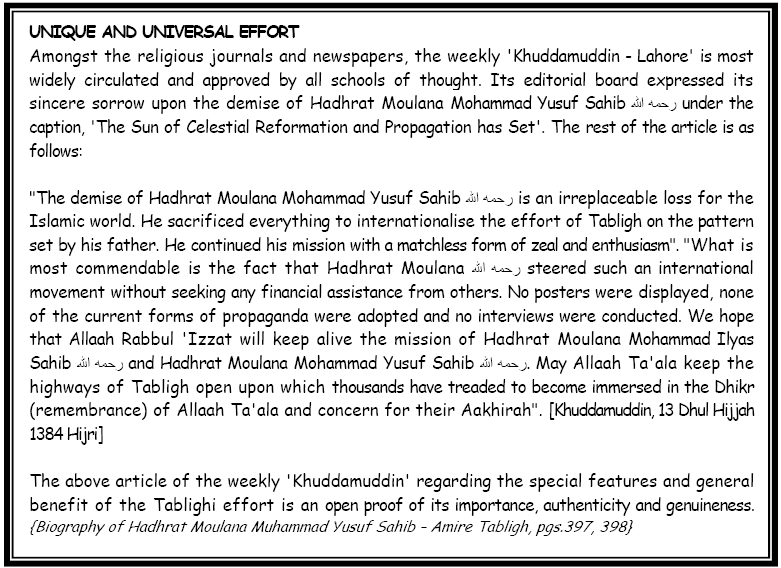
TABLIGHI JAMAAT: Universal and Unique Effort OF UMUMI DAWAH :JAMAAT-UT-TABLIGH

Tablighi Jamaat is doing the basic,crucial important ground work of bringing people towards Deen.

By Grace of Allah IT HAS SOME Unique qualities.........

1. It stress on Emaan ( correct faith) and Amaal e Saliha, Strssing on Command of Allah and following and love of Prophet Muhammad Sallallahu Alaihi Wasallam, that is core of any Revival Effort.
2. Approaching to all section of society. Rich Poor literate illeterate ranging from Street hawkers to Doctor Engineers celebrities like Inzamul haq and Juned Jamshed.etc.

3. It is spread in all corners of the world in every continent and Whole Ahle Sunnat Wal Jamaat and followers of four great Imams are participating. 

4. It is not only about reading listening  Audio/ Video talk but practical Dawah by each Muslim according to capabilities of Individual.

5. It bridges the Gap between Ulema and Common People by bringing them in Jamaat and co operating WA TAWANU ALAL BIRRE WATTAQWA.....

4. It gives Special Attention for Self Reformation.

5. It tries to follow the Manhaj of Prophet Muhammad Sallallahu Alahi Wasallam and Shaba Karam as close as Possible.

6. It never believe in Negative Dawah..........Accusation other group/Person and Counteraccusation that is very common now a days and eating Ummat Strength from Within.
7. It stress on Practicing Islam in all walk of Life,in all field.

OBJECTIVE OF TABLIGHI JAMAAT /JAMAAT-UT-TABLIGH
 Their objective is that each and every Muslim adopts the Islamic way in all aspects of life. They do not advice anyone to leave all their daily activities and join this work, but they encourage people to take out some time from their daily engagements so that the rest of the time could be spent in accordance to the teachings of Islam. Spending time in the path of Allah is not the objective of the work, but rather it acts as a motivation to practice on all other aspects of Deen.


Their call is based on Quran and Ahadith and always guided by Pious Ulema and Muftiyan Karam
Their  call is for complete deen and they say to people:
Our success in this life and the life hereafter is in obeying the commandments of Allah (SWT) and in following the noble ways (Sunnah) of Rasul-ullah (Sallaho Alaihe Wassallam)
There is ABUNDANT EVIDENT from the Qur’aan in their call as Allah (SWT) has said:
وَأَطِيعُواْ ٱللَّهَ وَٱلرَّسُولَ لَعَلَّڪُمۡ تُرۡحَمُونَ
[3:132]Obey Allah and the Messenger, so that you may be blessed.
قُلۡ أَطِيعُواْ ٱللَّهَ وَٱلرَّسُولَ*ۖ فَإِن تَوَلَّوۡاْ فَإِنَّ ٱللَّهَ لَا يُحِبُّ ٱلۡكَـٰفِرِينَ
[3:32] Say: .Obey Allah and the Messenger. Then, should they turn back, Allah does not love the disbelievers.
قَدۡ أَفۡلَحَ ٱلۡمُؤۡمِنُونَ
[23:1]Success is really attained by the believers
وَعَدَ ٱللَّهُ ٱلۡمُؤۡمِنِينَ وَٱلۡمُؤۡمِنَـٰتِ جَنَّـٰتٍ۬ تَجۡرِى مِن تَحۡتِهَا ٱلۡأَنۡهَـٰرُ خَـٰلِدِينَ فِيہَا وَمَسَـٰكِنَ طَيِّبَةً۬ فِى جَنَّـٰتِ عَدۡنٍ۬*ۚ وَرِضۡوَٲنٌ۬ مِّنَ ٱللَّهِ أَڪۡبَرُ*ۚ ذَٲلِكَ هُوَ ٱلۡفَوۡزُ ٱلۡعَظِيمُ

[9:72] Allah has promised to the believers, male and female, gardens beneath which rivers flow, where they shall live forever, and good homes in gardens of eternity. And Allah‘s pleasure is above all. That is the supreme success.
Tabligh Remind people as

They remind our Muslim brothers and Sisters to change their life according to Qur’aan and Sunnah and we believe that our reminder also has evidence from the book of Allah (SWT):
وَذَكِّرۡ فَإِنَّ ٱلذِّكۡرَىٰ تَنفَعُ ٱلۡمُؤۡمِنِينَ
[51:55] And keep reminding, because reminding benefits the believers.

How to actually change their life? We refer them to the Ulama (& people of knowledge) and we believe that we evidence for that from the book of Allah (SWT) as well:
فَسۡـَٔلُوٓاْ أَهۡلَ ٱلذِّڪۡرِ إِن كُنتُمۡ لَا تَعۡلَمُونَ


[21:7]...So, ask the people (having the knowledge) of the Message, if you do not know...


Shaykh Muhammad bin Saalih al-`Uthaymeen Fatwa on Dawah and Knoiwledge

Question:

Is da’wah (calling) to Allâh obligatory upon every Muslim man and woman, or is it to be left for the Scholars and the students of knowledge only? Is it permissible for the lay person to do da’wah to Allâh?
Answer:

“When a person has knowledge and insight into that which he is calling to, then there is no difference between the one who has a great amount of knowledge, or a student of knowledge who has recently started in pursuit of knowledge or a lay person - as long as he has certain knowledge of the issue at hand. The Prophet sallallâhu ’alayhi wa sallam said: “Convey from me, even if it is one verse.” [al-Bukhaaree] So it is not a condition upon the dâee (the one calling) to attain a great amount of knowledge, but the condition is that one must have knowledge of what one is calling to. If this calling is established upon ignorance and built upon emotion and passion, then it is not permissible.
Thus, we see that some of the brothers who call to Allâh, they do not have except a little knowledge. We see them, due to their strong emotions, prohibiting that which Allâh has not prohibited, whilst making obligatory that which Allâh has not made obligatory upon His worshippers. This is a very dangerous matter, since permitting what Allâh has made harâm (unlawful) is like prohibiting what Allâh has made halâl (lawful). So when they begin prohibiting people for making a particular matter then others will rebuke them for making it harâm. Allâh - the Most High - says: “And do not say, concerning that which your tongues falsely put forward, ‘This is lawful and this is forbidden,’ so as to invent lies against Allâh. Indeed, those who invent lies against Allâh will never prosper.” [an-Nahl 16:116-117] As for the lay person, then he must not call to Allâh if he does not have knowledge. Rather, it is essential to have knowledge in accordance with the saying of Allâh - the Most High -: “Say: This is my path. I call to Allâh upon sure knowledge.” [Yoosuf 12:108] So it is a must to call to Allâh upon knowledge. However, if a matter is clearly known to be evil or good, then one can command it - if it is good, or forbid it - if it is evil.

So the callers to Allâh must start with knowledge. Whosoever calls to Allâh without knowledge, then such a person will cause greater harm than good - as is evident. So it is obligatory for a person to first acquire knowledge, then to do da’wah. As for the clear evils and that which is clearly good, then the good is enjoined and the evil prohibited.”
Shaykh Muhammad bin Saalih al-`Uthaymeen
As-Sahwatul-Islâmiyyah (pp.75-76) of Shaykh lbn al-’Uthaymîn.

Work of Tablīgh is not the duty of Ulamā alone :Ashraf Ali Thanwi R.A.discourse

“Obligation of Tablīgh”,


[Continuing from the talk of
Maulāna Ashraf Ali Thānvi rehmatullāhi alayh says] These days some people have started to think that the work of tablīgh is the sole duty of ulamā. If it is the sole duty of ulamā then let these ulamā also keep fast on your behalf, and you may go ahead and live a life free of any religious restriction.


This is just like some villagers used to think and perhaps there is still a place where similar thinking may exist.........................................................

One Sahābi radiallāhu anhu had once requested Rasulullah salallāhu alayhi wasallam that he wishes to gain closeness to Rasulullah salallāhu alayhi wasallam in Jannah. So Rasulullah salallāhu alayhi wasallam said to him,

ولكن اعنى على نفسك بكثرة السجود
Help yourself through excessive prostrations..*

Thus Rasulullah salallāhu alayhi wasallam gave the solution for this request.


Anyone who wishes to be close to him salallāhu alayhi wassalam should rely on establishing plenty of Salāh. This hadīth clearly indicates that the benefit in these different turuq (pl. for tarīq ) is dependant on the condition that one who will tread the path of that Pīr (i.e practice on all the struggles and exercises of the tarīq )....................................... 


Anyway, what I was saying is that if Tablīgh was a sole duty of the Ulamā then we should hand over these Salāh and Fasts to some Pīr/Alīm as well and live freely. These Ulamā will carry the entire burden.


I do not say that there is no distinction

between the Ulamā and Laymen. 


The distinction is indeed there but the Ulamā are not the bearer for the entire task.


The detail in this is as follows:

Address (speech) is of two Categories,
  which are further divided into two types.

Category 1:
 A. General Address to masses


 B. Specific Address to individuals

Category 2:


A.   (Address pertaining major issues of Dīn).
خطاب بالمنصوص  


B.   Address pertaining to detailed issues of Dīn
خطاب بالاجتهاد 


In the above, from within “Category 1” the first type (i.e. General Address to masses) is restricted to the Ulamā.


Only their speech will be beneficial for the masses because people have trust in these Ulamā and see them as their leader. This is contrary to a layman who would not be beneficial in this type of an address because people do not regard him worthy of leadership and thus his address will not be effective.


As for the second type within this category (i.e. Specific Address to individuals), then this is not restricted to Ulamā. Anyone can give advice and guide another person on an individual bases.


Similarly, in “Category 2” the “خطاب بالمنصوص (Address pertaining major issues of Dīn)”


can be done by anyone and is not restricted to Ulamā. Anyone can give this speech aloud. This address refers to those issues which every muslim ought to know in any case, like “we should believe in Allāh”, “pray five times”, “fast the month of ramadhan” etc. 1

The last type in “Category 2” (i.e خطاب بالاجتهاد (Address pertaining to detailed issues of Dīn)) is restricted only for the Ulamā.


These addresses include specific issues pertaining to the laws of Shariah. Laymen will err in relaying such an address. An Alīm generally is aware of lot of maxims within the Shar’ī Law, so much so that he will not err, and even if one Alīm does not know a specific maxim then the glory of his knowledge is such that he will not shy away from saying “لا ادرى” (I do not know). Nonetheless, such issues require an in depth understanding.

Similarly to give an address to masses and then explain the Shar’ī rulings is restricted for the Ulamā,


while to address major and well known aspects of Dīn on an individual basis is not restricted to the Ulamā.


This is why Allāh mentions in one place:

وَلْتَكُنْ مِنْكُمْ أُمَّةٌ يَدْعُونَ إِلَى الْخَيْرِ…

There should be a group among you which calls towards good… (3:104)

Here the action of Da’wah has been made restricted to one particular group. And later on Allāh says:

كُنْتُمْ خَيْرَ أُمَّةٍ أُخْرِجَتْ لِلنَّاسِ تَأْمُرُونَ بِالْمَعْرُوفِ وَتَنْهَوْنَ عَنِ الْمُنْكَرِ
You are the best of nations who has been raised for the mankind. You enjoin the good and forbid the evil… (3:110)2

In this ayah, the task of enjoining good and forbidding evil has been kept general, hence everyone is addressed.


This also gives us the indication that enjoining good and forbidding evil has one particular level which is obligatory for everyone and is not restricted to Ulamā alone. The detail has been given above.

Aside from this, there is another distinction understood from these ayāt, between the role of Ulamā and the Laymen.


This distinction is that one group will be such that it will always be in the work of tablīgh by enjoining good and forbidding evil, while another group will be such that it will carry out this duty of tablīgh according to the time and place.


3 This is mentioned in the second ayah. This is called distribution of task and no nation can advance unless it has some form of distribution of tasks. Thus Ulamā’s role in Da’wah and Tablīgh is such that they are always engaged in it; while the laymen will do their part of Tablīgh is specific times and places (which ever are most suitable). This is because Allāh made the salvation from the loss dependent on Tawasī bil haqq and Tawasī bis Sabr in Suratul Asr; hence making this an obligation on ALL (ulamā and laymen alike)4.

Khutbāt Hakīmul Ummat, vol. 13, pg. 161-165

* الآحاد والمثاني – (ج 4 / ص 229) #2387

Notes From the lesson:

1. The work of Jama’atut Tablīgh will fall under this category where they call people towards one of the well known and established aspect of deen most important command of Dīn (i.e. Emaan, Salāh Zikr ,Ikrame Muslim Respect for Muslim,Correction of Intention etc).


2. No one should question about the difference of translation in two instances. In first ayah the أُمَّةٌ has been translated as “group” while the same أُمَّةٌ in the second ayah has been translated as “nation”. The reason is simple. In the first ayah, the word أُمَّةٌ is preceded by the word مِنْكُمْ (the مِنْ is called min tab’īdiyyah) which means “from among you”. If the whole Ummah is one nation, then a portion from it is a group of that nation, hence مِنْكُمْ أُمَّةٌ will be translated as “a group among you”.


3. Ulamā have said Labayk to the work of the Prophets alahimus salām, hence their duty entails a round the clock Da’wah, whether it is in the form of Addresses, Teaching, Writing, or Giving decree etc.


Where as the Laymen masses are also obliged to carry out their share of this duty, however they are only liable for whatever time they can spend aside from their normal life. The more time they will spend in this task, the more rewards will they reap.

4. This also makes an indication on the aspect of Jama’atut Tablīgh using their stipulation of specific days as an administrative measure to help laymen fulfill their religious obligation of Dīn.


However, one should note that the obligation is not limited to the time spent in these stipulated times, rather whenever they find an opportunity to advise a fellow Muslim brother, they should avail it.


Moreover, this stipulation of the time in Jama’at (aside from other many benefits) is only for him to learn how to carry out this obligation on an individual basis at times other than that spent in Jama’at.


5. Please note that Maulāna Ashraf Ali Thānvi rehmatullāhi alayh does not deal with the work of Jama’atut Tablīgh in these talks, however their understanding gives us insights about the issues related to this Jama’at as well.


Taken with thanks   http://qafila.wordpress.com/2009/09/06/work-of-tabligh-is-not-the-duty-of-ulama-alone/


(Full story of Villagers and Pir Sb in the discourse that he started  in the beginning is as follows ............................... 


This is just like some villagers used to think and perhaps there is still a place where similar thinking may exist


One Pīr sāhib (“saintly” person) came to one town and met the chief there. The chief saw that this Pīr was very frail and thin, so he asked, “O Pīr, you are very skinny. Are you even healthy?”


The Pīr replied, “Why should I not be so skinny when you people do not pray, so in your place I have to pray; when you people don’t fast, so I have to fast in your place; and what is even more difficult is that, instead of you I will be the one to cross the bridge in hereafter, the bridge that is thinner than a hair and sharper than a sword’s edge.”


The chief said, “Amazing! You do so much! Go I give you that certain farm land”

The Pīr thought for a moment that this fellow is a villager. There is no knowing when he will turn away from his statement so let me solidify this deal. The sooner I take ownership of the land, the better. Hence, he said to the chief, “Khan Sahib, then get me the ownership on that land.

The chief took the Pīr to the land. While they were going the passed through the ups and downs of the farm area, zigzagging through the canals and through a thin pathway (which is normally in between two farms and is slightly raised). This pathway was so thin, that the Pīr had to balance himself nicely. While balancing himself the Pīr slipped and fell into a ditch by one side of the pathway.

The chief saw this and gave a nice kick in the back of the Pīr and said, “You were saying that you will walk the bridge which is thinner than a hair and sharper than a swords edge and you could not even cross this pathway which is hand span wide! You lie. I take my words back; there is no land for you!”


 So these poor villagers (because of lack of knowledge) have made their belief that this praying and fasting is something for the Pīrs and Ulamā to do. We are not liable for anything. This is same as the Christians who say that Īsā alayhi salām has compensated for all the sins on their behalf. Moreover, some sufiya got this kashf (unveiling) that all of the followers within their tarīq (path of Tazkiyah) will be forgiven. When this information reached the (jāhil [ignorant]) inheritors in these tarīq , they started to misguide the masses with it. This kashf does not mean that the murīds (seekers) of that tarīq would neither have to pray nor keep any fasts. After all even Rasulullah salallāhu alayhi wasallam has also been promised that his Ummah will be forgiven, so should we now start to think that there is no need for Salāh and Fast for this whole Ummah?................................)