Pages

Showing posts with label Family Life Manners/Adab. Show all posts

Aqeeqah Method Sunnah Dua Ruling Masail Suplication How to sacrifice Qurbani

Bismillahir Rahmanirraheem

For other Bakreed/way of Qurbani/Udhuhia/Dua click the links

1. URDU   Language   (Tareeqa aur Masael)

2 ENGLISH           (Ruling, Method and Dua while slaughtering) 

Many other article on this link about Qurbani etc   


Aqeeqah on the 7th day:

Aqeeqah (sacrifice) is a noble Sunnah to remove harm from the baby.
Sayyidina Salman bin 'Amir (RA) reported that Allaah's Messenger (Sallaho Alaihe Wassallam) said: A 'qeeqah is prescribed for every child. Thus shed blood on his behalf; and remove the harmful thing from him. [Tirmidhi]
It is also from the noble Sunnah to sacrifice 2 animals for a boy and one animal for a girl on the 7th day with the intention of Aqeeqah.
Sayyidah 'Aa'ishah (RA )reported that Allah's Messenger (Sallaho Alaihe Wassallam) said: (The 'aqeeqah is) two [equivalent ] sheep for the male child, and one for the female. [There is no harm whether they be male or female animals.] [Ahmed]

Feasting and distributing Aqeeqah meat:

It is recommended for a person to feast and also share the meat with family, friends and loved ones and also distribute some of it to others.
Sayyidah 'Aa'ishah (RA) said concerning the meat of the 'aqeeqah: "It should be cut into pieces, then eaten and given to others." [Ibn Abi Shaybah ]
It was narrated that Sayyidina Ibn Seereen (RA)  and Sayyidina Hasan al-Basri (RA) said: "Among them the 'aqeeqah was dealt with like a sacrifice; some would be eaten and some given to others." [Ibn Abi Shaybah ]

Shaving the head on the 7th day:

Then it is from the Sunnah to shave the head of the child and it is preferred to start the shaving from the right hand side.
Sayyidina Samurah ibn Jundub narrated : The Prophet (Sallaho Alaihe Wassallam) said: A boy is in pledge for his Aqiqah, Sacrifice is made for him on the seventh day, his head is shaved and he is given name. [Abi Dawud]
Sayyidina Anas ibn Malik (RA) reported that Allah's Messenger (Sallaho Alaihe Wassallam) came to Mina; he went to the Jamra and threw pebbles at it, after which he went to his lodging in Mina, and sacrificed the animal. He then called for a barber and, turning his right side to him, let him shave him; after which he tiimed his left side. He then gave (these hair) to the people. [Muslim]


Aqueeqa (sacrifice) of an animal for a newly born child and the removal of the baby's hair
MAS'ALAH No 1: When a child is born, male or female, it should be given a name on the seventh day of birth. When the hair of the head of the baby is shaved, a sacrifice is also offered which is called AQUEEQA. By Aqueeqa all impurities of the child are removed and the child is saved from all calamities by Allah. 
MAS'ALAH No.2: The method of performing Aqueeqa is that for a male child , two goats or sheep and for a girl one goat or sheep is sacrificed. If an animal of seven shares (cow or camel) is used for Aqueeqa, then two shares will be taken for a male and one for a female. The hair of the head is then shaved. Silver, equal to the weight of the shaved hair is also given in charity. However, this is not compulsory. 
Mas'alah No.3: Aqueeqa is performed on the seventh day of the birth of a child. If not done on the seventh day, then, whenever it is done, it should be the seventh day, e.g. if the child was born on a Friday, then Aqueeqa should be performed on the following Thursday (the 7th day after birth). If it is not performed on this Thursday, then any other Thursday. 
MAS'ALAH No 4: That animal which is not permissible for Qurbani is also not permissible for Aqueeqa. Requirements for the animals of Qurbani and Aqueeqa are the same. 
MAS'ALAH No.5: It is permissible to distribute the meat of an animal of Aqueeqa raw or cooked, and can also be served to guests. 
MAS'ALAH No. 6: If one does not possess sufficient money, then it is permissible for such a person to sacrifice only one goat for a male child. There is no harm if Aqueeqa is not performed, provided one does not have the means for Aqueeqa. 
MAS'ALAH No.7: Before sacrificing the animal (for Aqueeqa), the following Du'aa may he recited:- 
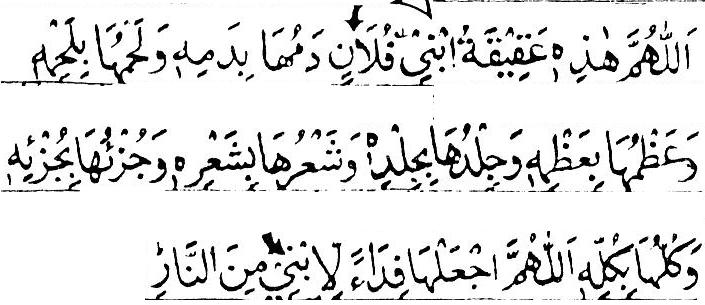
"O Allah I sacrifice this animal in Thy name as a sadqa for my child in substitution. Blood for blood, flesh for flesh, bones for bones, skin for skin and hair for hair. O Allah accept this sacrifice for the protection of my CHILD from HELL."
If the aqeeqa is for a girl then in place of  say  and mention the name of the child boy or girl at this point 
Du'aa for slaughtering: Lay the throat of the animal towards the Qiblah and recite: 

"For me I have set my face, firmly and truly towards Him Who created the heavens and the earth And never shall I give partners to Allah. Verily my worship and my sacrifice, my living and my dying are for Allah. Lord of the worlds O Allah this sacrifice is from you and is for you."
While slaughtering the animal read: 

 
"In the name of Allah, Allah is the greatest."

Being Reproduced with Jazakallahu Khair with contribution from www.central-mosque.com AND http://www.inter-islam.org/ 

For full detail click these link http://www.central-mosque.com/index.php/Relationships/welcoming-a-child.html  AND 

http://www.inter-islam.org/Actions/Part13.html#Aqueeqa%20%28sacrifice%29%20of%20an%20animal%20for

Hadith Bukhari Justice equality among all children in Islam

Fair and equal treatment of children:

Young children are sensitive and Islam teaches that the parents should be fair, equitable and just in treating their children. Human feelings are sometimes beyond ones' control but tangible actions should be well thought out and fair treatment of all children should be ensured.
Sayyidina 'Amir (RA) narrated: I heard An-Nu'man bin Bashir on the pulpit saying, 
 "My father gave me a gift but 'Amra bint Rawaha (my mother) said that she would not agree to it unless he made Allah's Apostle as a witness to it. So, my father went to Allah's Apostle and said,

 'I have given a gift to my son from 'Amra bint Rawaha, but she ordered me to make you as a witness to it, O Allah's Apostle!' 

Allah's Apostle asked, 'Have you given (the like of it) to everyone of your sons?' He replied in the negative. Allah's Apostle said, 'Be afraid of Allah, and be just to your children.' My father then returned and took back his gift."
 [Bukhari Shareef]

Hadith Looking after for three sisters or daughters in Islam

Reward for looking after three sisters daughters

 Abu Sa'id al-Khudri  may  Allaah  be  pleased  with  him said that the Messenger of Allah,  sallallaahu  `alayhi  wa  sallam ( may  Allaah exalt his mention ) , said, "No one has three daughters or three sisters and is good to them but that he will enter the Paradise."
[(Al Adab Ul Mufrad 79) Imam Bukhari Rahimullah collection of Ahadith]

Hadith Islamic Ruling on Guest treatment hospitality etiquette in Islam

Rasulullah Sallallaho alaihe wasallam 
has said that whoever has faith in Allah Ta’ala and the ‘Akhirah’ needs to honour his guest; a guest is entitled to special treatment for a day and night, while hospitality may be extended for three days and nights; it is not proper for the guest to stay too long, as it may cause hardship to the host. (Mishkaat)

Note: This Hadith lays down two points of etiquette, one each for the host and the guest. The courtesy to be shown
by the host is that, if he believes in Allah Ta’ala and the Akhirah as has been mentioned in the previous Hadith, he
must honour his guest, which is to treat him broadmindedly and talk to him politely. One Hadith says that a person
should accompany his guest upto the door.
Uqbah Radhiallaho anho has quoted Rasulullah Sallallaho alaihe wasallam as saying that whoever does not show
hospitality is devoid of virtue. Samorah Radhiallaho anho says Rasulullah Sallallaho alaihe wasallam used to
entertain a guest with a feast. Someone saw Ali Radhiallaho anho weeping and asked him the cause. The reply
was that seven days had passed without his having entertained a guest and he feared lest Allah Ta’ala might intend
to dishonour him.
Rasulullah Sallallaho alaihe wasallam ordered that a guest be treated well and given special treatment for a day
and night. The latter point has been explained differently by Ulama. Imaam Maalik Rahmatullah alaihe says that he
may be shown special favour such as presents or special food for one day and night, and normal food (of the
family) thereafter.

Tips to Wake up for Fajr Salah Some simple manners and care


Tips to Wake up for Fajr

1) Go to sleep with wudu. Perform two rakahs salah and ask Allah for Hidayah and Guidance.

2) Recite at least 10 ayah of the Holy Quran, because Rasulullah said to recite at least 10 ayah of the Quran so you don't get counted amongst the neglectful and be in the state of "ghaflah" (neglect).

3) Catch the Jamat in the Masjid. Invite others to also catch it. Rasulullah says, Whoever performs Salatul Isha with Jamat and performs Salatul Fajr with Jamat will get the ajar and thawab (reward) for doing worship all night. The following link provides further information about importance of Salah with Jamat, click here.

3) Make sincere dua to Allah (ta'ala) to give you the ability to wake up. Make big intentions. Not just "oh Allah please give me the ability to wake up for Fajr." Instead make intention for Tahajjud and/or catching Takbirullah in the Masjid.

4) Do the Tasbeeh of Fatimah before going to sleep. Subhanallah 33x, Alhamdulillah 33x & Allahu Akbar 33x. It comes in the narration that by doing this tiredness will be removed after waking up.

5) Go to sleep early without wasting time and indulging in frivolous activities. It is best to go to sleep immediately after Isha. Best way to feel tired and push one self to go to sleep early is when you do wake up for Fajr, stay up and not go to sleep afterwards. By doing this you will notice that by the time you hit nightfall you will feel tired and automatically fall asleep.

6) Avoid using the Shaytaan button (the snooze button). The only thing this does is make you miss the time of Fajr.

7) Keep the alarm clock away from easy reach. By doing this, you will have to get out of bed.

8) Don't eat late. Try to eat at least 2 hours before going to sleep. If you eat and go straight to sleep, you will feel tired when waking up.

9) Create a cycle of calling and ringing one another. By this if someone does wake up and perform salatul Fajr, we will get the ajar and thawab (reward), subhanallah!!!

10) A really effective "wakerupper" is doing some quick pushups and sittups. This gets the body immediately rejuvenated.

11) Ask someone to come and wake you up. For example: wife, mother, daughter, husband, etc.

12) As soon as you wake up, rub your face with your hands. By doing this, sleep will ward off. It is Sunnah to do this and recite verses 190 - 194 from Surah Al-Imraan.

13) Fight the nafs and get up. Nafs will say "few more minutes." Those few more minutes will lead you to miss Salah completely.

14) If the above tips are not working, make your bed less comfortable at least for few days.

http://www.minsid.com/Articles/Tips_to_Wake_up_for_Fajr.html taken with thanks and dua for Akhirah

Spouse search etiquette Before Marriage and spouse manners after marriage


Husband
Spouse Etiquette
1. When marrying, choose a pious partner.

2. The marriage is not valid unless both people agree to get married and are not forced into it.

3. The couple should love one another and never be cruel or mean to each other.

4. Allah says husbands and wives are a comfort for each other and try to be most kind to one another. Husbands must not be tyrants, but rather a just and kind ruler of the house.
Similarly, wives should not be stubborn and insensitive to her husband unless it is a violation of Allah's law.

5. Husband and wife should respect each other, consult one another, and they should not let the Satan come between them.
The Satan is happiest when he has divided husband and wife.

6. They should give each other their rights and help each other to do good.
They should take proper responsibility for their families and children in providing for them, loving them, and bringing them up Islamically.

7. They should trust each other and depend on Allah. Believing men and women will each get their full rewards from Allah and Allah values both of them.

8. When they have problems they should try to achieve peace through understanding and kindness.