Pages

Showing posts with label Gasht Joula Fazail Ahdith and Adab. Show all posts

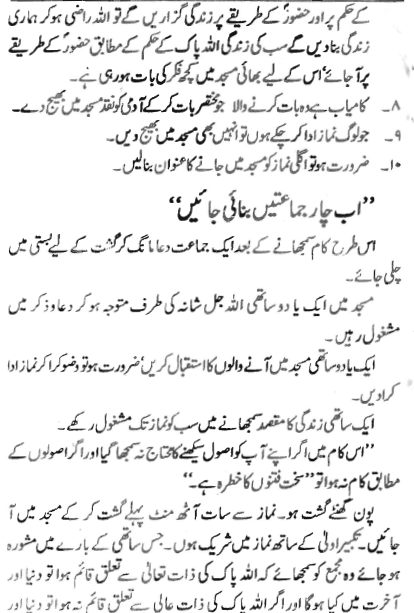
تبلیغی جماعت خصوصی عمومی وصولی گشت اخلاص کے ساتھ اصول کو پابندی ملحوظ رکھ کر گشت کیا جائے

گشت
جماعت تبلیغ کے اصول وضوابط کے تحت کچھ مسلمانوں کا  
 مل جل کر حکمت کے ساتھ دین کی دعوت دینے کی خاطر 
 جانا چلنا ملاقات کرنا گشت کہلاتا ہے

 عمومی خصوصی گشت
، اگر عام مسلمانوں سے ملاقات کرکے دعوت دینا مقصود ہو تو عمومی گشت ہے اور خواص مثلاً علمائے کرام، حکام، اور بڑے لوگوں سے ملاقات اوراپنی بات دینی پیش کرنے کا نظام ہو اور اسی کی خاطر خواص سے گفتگو کی جائے تو خصوصی گشت ہے
 
 وصولی گشت
 اور جن لوگوں نے جماعت میں نکلنے کا ارادہ کرلیا ان کو اعزاز واکرام کے ساتھ لانا وصولی گشت کہلاتا ہے،

 یہ سب امور قرآن کریم حدیث شریف سیر و تواریخ سے ثابت ہیں۔
اخلاص کے ساتھ اصول کو پابندی 
ملحوظ رکھ کر گشت کیا جائے تو اشاعت دین اورحفاظت دین نیز تقویٰ طہارت ادائے حقوق پر آمادگی اور ہمدردی، انابت الی اللہ ،حصولِ سعادتِ دارین، وغیرہ جیسی صفاتِ حسنہ کے وجود میں آنے کا بہت قوی ذریعہ ہے، حمیتِ ایمان وغیرتِ اسلامی اور نیک جذبات پیدا ہونے کا سبب ہے، گناہوں سے محفوظ رکھنے اور رہنے میں گشت کو بہت بڑا دخل ہے۔

Gasht Umumi Joula Adab etiquettes Maulana Yusuf Advice taken from his letter


How to start and Adaab/etiquettes
So we need to request the people to stay in the masjid by making an announcement after a salaat. It is better if the announcement is made by an influential person of the locality or by the imam of the mosque. If he tells us to do, then one of our brothers may make the announcement. Then we should tell them the necessity, virtues and the importance of gasht and encourage them to join the gasht.

Whoever agrees to take part we should explain the etiquettes of the gasht properly.

We need to go with zikr of Allah and lower our gaze. All our problems are connected with Allah. All the materials in the market have no connection with our problems. We
should not look at materials or draw attention to them. If by chance we look at them just think of them as a piece of earth. If our heart is influenced by these materials, how
can the heart of those whom we are visiting divert from these materials to Allah?

We should have the life of the grave in front of us. One day we have to go under the earth. We should walk together.

When talking only one person should talk. A successful
inviter is the one who gives only a short dawaah and gets the brother out to the mosque.

What to talk in Gasht
“Brother. We are Muslims. We have recited the kalmia: la ilaha illallah, muhammadur rasulullah. Our belief is that Allah is the sustainer. Profit and loss, dignity and respect
are only in the hands of Allah. If we spend life according to the orders of Allah and the ways of the prophet S.A.W, then Allah will be pleased and grant us success. The life of each one of us should be according to the ways of the prophet S.A.W. Concerning this there is a Lecture in the mosque.” Even if he has completed his salaat, take him to the masjid immediately.

Use the reason of joining the next salaat to encourage him to go to the masjid immediately. “Allah's greatest command is salaat. If we are punctual in salaat Allah will increase our sustenance, forgive our sins, and will accept our Dua. Give them good tidings and not warnings. That the time of salaat is ending so please come to the masjid now.”
Other Etiqueetes
We have to obey the Amir. Return and make istaghfar (repentance) on the way back. Now, after concluding the discussion of etiquettes, go out for gasht by making Dua.
Ten brothers should go to gasht. Do gasht in the houses near the mosque? If there are no houses, then do gasht in the shopping area. The majority of brothers in the jamaat
should be those who follow the etiquettes property. Leave two or three brothers in the mosque. If there are many new brothers explain to them the situation and leave them
in the mosque. Only three or four new brother should be in the gasht.
One brother should remain in zikr Dua to Allah with concentration.
One brother should welcome those who are arriving in the mosque.If necessary ask the arriving brother to make wudhu and complete his missed salaat.

First one brother should sit and continuously talk to the brothers until the next salaat. Explain the objectives of this life.

Gasht should last for 45 minutes.

End the gasht seven or eight minutes before salaat. Everybody should join the salaat early, with the first takbeer.
What to talk in Bayan in Mosque after gasht
Whichever brother is selected should give dawaah. Explain that, if we develop connection with Allah, what
will be its benefit in this and the next life, and what will be the loss in this life, and what will be the loss in this life and the next life if the connection with Allah is not
developed.
Talk about the six qualities as mentioned at the beginning of this letter.
Speak about their objectives,
their virtues and rewards
and the methods of acquiring them.
The talk should be in simple language. This will help in making the gathering's listeners understand easily and they will feel that they also can learn them.
Our brothers should also sit in the talk with punctuality and listen attentively, felling its necessity.

Whatever is being spoken we should confirm it in our heart as being the truth. This will raise waves of Imaan (faith) in the heart, and create a zeal for practicing.

How to do Special Joula (khususi Mulaqat) meeting Muslims Community leaders individually Adab and Etquetes


Special (khususi Mulaqat) Joula Adab and Etiqueets

MOST IMPORTANT THING


YOU WILL LEARN ALL THESE ONLY IN THE PATH OF ALLAH WHILE DOING PRACTICALLY AND GRADUALLY. These are only Guidelines that will help you to be focussed and making a good learner.


1. Composition:
In this kind of joula, try to get 2-3 brothers mostly experienced besides the guide. Anyone can start talk but make a general agreement before you meet any person who should start ftrst, who next, and so on. It will avoid conflict or misunderstanding, duplication, confusion, etc. Be a smart dayee. Amir of this Joula should organize. 

3. Be Merciful to Ummat:

Here we are just visiting a Muslim brother, he is an ummat of Rasul :I, he needs to work for Deen with the talents and expertise he posses and can excel ahead of many of us. We need to go in joula with the importance in values and attitute ofakherat. Otherwise our Da'wah will have little impact or affect.

Talk with Ikram e Muslim: We must talk with ikram, respect without humiliating a Muslim. It is important. In fact, you talk with ikram, praise about how much he is serving the community, what a wonderful job

he is doing, etc. Using this approach, try to get his attention, he will feel comfortable, he will think you are his well-wisher, he will listen to you. Then you talk about grave, Akherat..


3. Talk with Hekmat:

When one brother talks, others should make zikr to request the help of Allah so that Allah can change the heart and accept him for the work of Da'wah.

The talk or discussion should follow a sequence....

when one stops, the next person should continue from the ftrst person keeping the same subject, trend, flow, etc. The second person should not start allover again rather continue from the fIrst person's talk. Talk should be concise, to the point with specifted goals, not at random.


5. Talk must Converge: Remember you are talking to a leader.. .if you talk at random, he will think you are wasting his time and it will not make any sense to him. In many instances when this happens,

the leader himself starts talking and takes over the talk, agenda, his accomplishments, how much he has done for the community, etc.

LEAD FROM THE FRONT OTHERWISE........

The whole joula is sidetracked. Jamat brothers return back without any taskil rather get lot of exposure to worldly things whieh the leader was talking about and in many instances, get lot of advice on what to do, how to do, whaT not to do, etc. In fact it hurts the jamat brothers. So in order to avoid this kind of scenario, right at the beginning, guide should make a request to the leader that these brothers have come from out of town to talk with you for few minutes. The jamat brother may introduce himself to the leader with his background even worldly position such as I am so and so. It gets leader's attention otherwise the leader will think these people came to him for some favor or

money or they have nothing to do.

You cannot blame him for that as he is doing this kind of favor everyday, it it not new to him. Jamat brother should be talking.... about grave, akherat, life after death. You should never discuss worldly issues, events. In that case, he is the leader and expert in this fteld. He will take over and solve all these issues. When you talk about akherat, he will be silent; he cannot help but listen to you. He himself needs it, he has no choice,no solution, and will listen.


6. No worldy value: We must remember our mission: if this leader (no matter how big or famous he is) obeys Allah, participates in Da'wah, he will be successful. His worldly success has very little  value in the eye of Allah. That is why it is important that old workers should go in this kind of joula. Unless this joula is done properly, it can morally or spritually hurt jamat brother and he will return with the regreat that he does not have those things the leader has, so many things he is missing because he is in jamat. It is also

important to keep eyes down, do not look around to see his worldly possesions and values. The worldly possessions and materials have no value in the eye of Allah. The worldly materials and values should never affect us. These are temporary and' all will be destroyed. When the poor companions of Rasul :I went to the Roman and Persiam kings; those palaces, wealth, glamour, beauty, etc never affected them. They were very firm on the powers of Allah, importance of akherat, severity of Allah's punishment if

disobeyed, only success in the obedience of Allah's orders, etc. Those poor companions of Rasul ~ used give Da'wah to those rules: either accept Islam and live peacefully or give tax and offer freedom to public to choose Islam if anyone wants to.


6. Take Control of Talk: Joula brothers must take control of the talk from beginning to end. We might offer the leader a chance to talk , but most of the time (80-90%), jamat brothers should be talking and controlling the talk.


7. Find Connection: Many times, it is easier to visit a big leader through his acquintances. Do not just do a quick job of visiting a leader. Find good connection, visit him first. Convience him about

the imporantance of Da'wah, akherat and then use his connection to reach the big leader.


9. Feel Comfortable: If you can make him feel confortable, he will listen even if he is busy. Many times, he offers tea, coffee, etc. It is OK to accept. Take time especially if he is willing to give time. You

will be closer to him. Rasul :I used to talk with people and used to fmd connection with his family. The person very soon realized that Rasul :I is his well-wisher and became ready to listem. It is the

Hekmat, which matters...how you present your approach, talk, humbleness, etc.


10. Avoid Controversy, be focused:

It is very important to avoid controversial talks, worldly events, politics, current events, Masail, crticize other Islamic activities, etc. This kind of topic creates

argument, sharp disagreement, and bitterness. Our main thrust is akherat, grave, life hereafter, etc. This will keep your talk: and discussion focused.


11. How long talk? It depends on the atmosphere where you are talking. In some instances, the leader is busy, you have only few minutes. In such case, try to take time for another visit rather than talk briefly.

In some place, talk can be interesting and last longer. However we must always gage him how he is listening? We should not force the discussion. It should be friendly atmosphere.


12. Taskil him: If you are close in talks, you might taskil him for some time right there. How much you can taskil depends on your approach, how busy he is. The situation might be favorable to aSk for his time to benefit the jamat in terms of visit to other important people in the community, as he knows lot of people. At the same time, you need to be careful whether you should get his help as he has many enemies where you will not be able to visit with him. In such situation, it might be better to go alone with the guide. The bottomline is that he makes some intentions to give time and come to the masjid. If he comes to the masjid, take care of him, offer his some tea, coffee, snack, food; let a different brother talk: with him in more details, Taskil him for longer time, etc.

13. No Time Limit: In special joula, there is no fixed time to return. You can continue as long as your efforts are useful. Take time and keep in touch with the Amir of the jamat if you have to.

Adab e GASHT/ghusht by Mufti Ibraheed desai of Ask Imam in English and by Maulana Yusuf R.A.,and explained by Maulana Saad of markaz Nizamuddin delhi in Urdu meaning


What is adab-e-gasht??what should we talk while giving adab-e-gasht?please reply in details?what are the adabs?
http://www.askimam.org/fatwa/fatwa.php?askid=ea60b9ded6d4004554e2f33df1d10877
Question

what is adab-e-gasht??what should we talk while giving adab-e-gasht?please reply in details?what are the adabs?

Answer

The word Adaab means etiquette. Thus, Adab-e-Ghust would mean etiquettes of carrying out the Ghust. This term comprises of two components. The first being the Targheeb (encouragement talk) and the second being the directives of how to carry out the actual Ghust correctly. With regard to the first part, encouragement should be given as to how the Prophets and Sahaaba [radhiallaahu anhum] sacrificed their lives to ensure that Deen prevails on earth and all falsehood be removed. Therefore, the talk should be given as to how we can also achieve this same concern which the Prophet (alayhimus salaam) also had. With regard to the second part, i.e. the etiquette, this comprises of the directives given in the Qur’aan, Hadith and pious elders as to how to leave the Musjid, how to interact with others especially when visiting them at their homes, etiquettes of travel, etc.

All these directives and others make up Adaab-e-Ghust.

Etiquettes in Brief

Groups will be formed comprising of 3-10 persons. 3 people will be specifically appointed and given extra responsibilities. The first being the Ameer who will ensure that the groups, going out for Ghust. Leave the Musjid with due consideration to the etiquettes. The Jamaat should gather and make a du’aa outside the Musjid. They should walk on the right hand side of the pathway there keeping the gaze lowered from all Haraam, especially women. The Jamaat should walk together. If travelling by car, the appropriate du’aas should be recited when embarking and disembarking.

The second person is the Mutakallim. He is the spokesperson of the Jamaat. His speech should be addressed to the entire Jamaat and not specifically focussing at the person who is being visited. His talk should be centred around our short stay in this world, everlasting life of the hereafter and our desperate preparation towards it. The third being the guide. He will show the Jamaat the Muslim homes, inform them of the name of the brother and his occupation and never to expose any fault of his to the group. He will knock at the door, not to look inside at anytime. He will request to see the menfolk of the house.

One or two persons will be chosen exclusively to remain in the Musjid for making Dhikr and du’aa. This group is regarded as the powerhouse of the Ghust Jamaat, i.e. imploring Allah for divine help in assisting those out for the Ghust.

Nb. These are just the general etiquettes. However, these may change according to time, place and situation. It is, therefore, advised that you find out more about the finer details from one of the local persons in your area who is acquainted with these etiquettes and principles. Remember, by you physically doing the Ghust, you will learn and understand these etiquettes as compared to just theoretically memorising it.

and Allah Ta'ala Knows Best

Mufti Ebrahim Desai


Fazail o Adab of Gasht Umumi Joula (General meeting Etiquette and virtues) From Quran and Ahadith and English and Urdu meaning and Translation

(Modified from the book Dawah netiquettes with some addition. To download click the link http://www.islamicbulletin.com/services/details.aspx?id=313
Etiquette Adab of General (Umumi Gasht) Joula

Whoever spends his morning or evening in the way of Allah, his reward will be much better than the world, and whatever is in it. (Bukhari). 

When the dust of the path of Allah enters the body of a Muslim, Allah prohibits Hell-fire on him. (Ahmad, Tabarani).

Purpose
Ahadith e Nabwi Sallallahu Alaihi wasallam has described Meeting with brothers in Islam for the sake of Allah is a virtuous act.Gusht (in Urdu/persian JOULA inArabic Meeting in English) means to go around.
We also use this terminology to visit our brothers of the locallity to give Da'wah and to make them connected with command of Allah and Path of Muhammad sallallahu Alaihi wasallam by means of connecting them to Mosque.

All prophets used to do this efIort on a full-time basis.
Rasul Sallallahu Alaihi Wasallam used to do this effort by going to house and in places in Makkah in fair and market places . 
At times he used to start since morning upto Zawal (afternoon) used to return with full of dust.Daughter Fatma Raziallahu Anha used to clean him.

We will do joula as ...


1. As a follower of Last Rasul Sallallahu Alaihi Wasallamwe are responsible not only to practice Deen but also propagate Deen.


2. As a sunnah of Rasul Sallallahu Alaihi Wasallam,we should do the work of Dawah.


3. Rasul Sallallahu Alaihi Wasallam is rahmatullil alamin, we are responsible to do Da'wah, to take his message· to the farthest coner of the world as his Sahaba/companions did.


From the Holy Quran:
 1.  
ادع إلى سبيل ربك بالحكمة والموعظة الحسنة
Invite (people) to the way of your lord with wisdom and good counsel.    (Verse: 16:125)
2.
ولتكن منكم أمة يدعون إلى الخير ويأمرون بالمعروف وينهون عن المنكر
And there has to be a group of people from among you who call towards good and prevent from evil. (Verse: 3:104)
3.
ومن أحسن قولا ممن دعا إلى الله وعمل صالحا وقال إنني من المسلمين
 And who is better in utterance than the one who called people towards Allah, and acts righteously and says, “I am one of those who submit themselves (to Allah Ta’ala).  (Verse: 41:33)
 From the Ahadith of Nabi (Sallallahu Alaihi Wasallam):
4.
فقال أبو سعيد أما هذا فقد قضى ما عليه سمعت رسول الله صلى الله عليه وسلم يقول من رأى منكم منكرا فليغيره بيده فإن لم يستطع فبلسانه فإن لم يستطع فبقلبه وذلك أضعف الإيمان
Hazrat Abu Sa’eed (Radhiyallahu Anhu) narrates that he heard Nabi (Sallallahu Alaihi Wasallam) saying, “Whosoever witnesses a forbidden act being committed, he should prevent it by the use of his hands; if he is unable to do so, then he should prevent it with his tongue; if he is unable to do so, he should at least consider it a vice in his heart; and this is a very low level of Iman”.
(Sahih Muslim Vol.2 Pg.211/2 - Darul Ma’rifah)
5.
عن النعمان بن بشير رضي الله عنهما عن النبي صلى الله عليه وسلم قال مثل القائم على حدود الله والواقع فيها كمثل قوم استهموا على سفينة فأصاب بعضهم أعلاها وبعضهم أسفلها فكان الذين في أسفلها إذا استقوا من الماء مروا على من فوقهم فقالوا لو أنا خرقنا في نصيبنا خرقا ولم نؤذ من فوقنا فإن يتركوهم وما أرادوا هلكوا جميعا وإن أخذوا على أيديهم نجوا ونجوا جميعا
It has been reported on the authority of Nu’man bin Bashir (Radhiyallahu Anhu) that Nabi (Sallallahu Alaihi Wasallam) said, “There are people who do not transgress the limits (laws) of Allah Ta’ala, and there are others who do so. They are like two groups who boarded a ship; one of them settled on the upper deck, and the other on the lower deck of the ship. When the people of the lower deck needed water, they said, “Why should we cause trouble to the people of the upper deck when we can have plenty of water by making a hole in our deck”. Now, if the people of the upper deck do not prevent this group from such foolishness, all of them will perish; but if they stop them, they will be saved”.
(Sahih Al Bukhari Vol.3 Pg.152 - Darul fikr)


Virtues ofJoula/Fazaile e gasht ( Allah promises and Fazail)


1. Whoever spends his morning or evening in the way of Allah, his reward will be much better than the world, and whatever is in it. (Bukhari). 


2. In the path of Allah Spending 'l will bring reward of 700,000 sadaka; every action will be rewarded 700,000 times(Ahmad) 


3. Few moment's concern for Deen is equivalent to prayer in front of Hazre Aswad of Kaba on the night of Lailatul Qadr . (Ibne Hibban).  Hazre Aswad (reward100,000 times),Lailatul Qadr (reward better than 1000 months)


4. Striving in the path of Allah for a short while, is far better than your good deeds for the whole life staying with your family. (Hakim). 


5. When the dust of the path of Allah enters the body of a Muslim, Allah prohibits Hell-fire on him. (Ahmad, Tabarani).


6. The fire of hell will not reach anyone whose feet become dusty whilst he is on the path of Allah. (Ahmad) 


7. Omar Raziallah u Anhu as Amirul Muminin held the rope of the camel when Maaz was departing for Yemen.
Omar said to Maaz. the Du'as of the person traveling in the path of Allah are accepted as the Du'as of the prophets of Bani Israel.


8. He who suffers a headac in the path ofAllah, and hopes for a reward, then all his past sins are forgiven. (Tabarani).


9. Whoever guides others to do good, his reward is like the one who does it. (Abu Dawud).

Below is the Gasht Adab by Maulana Yusuf R.A. and explained by Maulana Saad in the book CHAAY NUMBER KI MEHNAT


Manners/Adab e Gasht of Umumi Joula(General meeting Etiquette 


1. Correct your Intention before going- visit is only for the pleasure of Allah.


2. Make two groups:
one group will go and visit brothers.

Rest of the brothers will stay in the masjid. 
Amir will assign brothers: one in Zikr, one will be talking (not reading) to the brothers in the masjid

till before Magrib salat; one brother in Istekbal to receive anyone who comes to the masjid and request him to join the discussion after his salat if not perfonned already.


3. The brother, who is making zikr, can stop zikr when brothers who went to joula return.


4. Make lot of Du'a before going for joula. Show your humbleness to Allah; express your weakness, helplessness. 
Ask Allah to help and change the hearts of the brother visited, save from the nafs and Saitan during joula.


5. Try to do your joula before the prayer time. Generally it is done after one salat until the next salat and bayan is made after the next salat.

Timing of the joula should depend on the availability of the brothers who will be visited.

If they are not available at a certain time, no joula should be made at that time.


6. There is no hard and fast rule to do jawla after asr and bayan after Magrib. 

Discuss with local brothers to decide the time ofjoula.

Also on many occasions, even local brothers who are doing joula for so long, did not evaluate when is the best time on the availability of local brothers to visit. So if your jamat really wants to do an effective joula, discuss the local situation thoroughly and then decide.


7. Go as a jamat with one Amir (responsible), one Dalil (guide), one Mutakallim (spokesperson).


8. Go with Zikr - subhanallah alhamdulillah walailaha illallahu allahu akbar. and 
Lailaha Illallahu Wahdahu La Sharikalahu ...............if in market place.                 THESE ZIKR EXPRESS GREATNESS OF ALLAH.


9. Keep eyes down, it is an arrow of Saitan.


10. Go along the right side of road.


11. Go with great respect for that person visiting. Do not have low feeling regardless of what we see or know about the person visited.


12. Allah advised Musa alaihis ssalam to go to Pheroh (who was not a believer) and invite him towards Allah with cool mind...(Ta-Ha:44).


13. Your attitude will affect the hearts of the brothers being visited. Go with great wish that the brother (visiting) will come to the Masjid immediately to get maximum benefit.


14. Dalil will knock (maximum 3 times) as sunnah.
If there is no response, brothers should leave.


15. If the brother opens the door, dalil will introduce the brother to the Mutakallim.


16. Mutakallim should give salam and make musafa/handshake warmly and give Da'wah primarily on Kalima Tayyiba, remind him briefly about the importance of Iman, akherat life after death ,  obedience of Allah, etc


17. Mutakallim should not insist on hearing the brother's recitation of Kalema nor compel him to recite or perform salat. Such attitude from the mutakallim may hurt the feeling of the brother.


18. Mutakallim should not act as a police to enquire and charge the brother.


19. Mutakallkim should not call to prayers rather request him to join in the talk at the masjid. Once he is ready to go to the masjid, he will also pray.


20. On the other hand, this brother is not probably praying at all. So if Mutakallim asks him to pray, then he will simple not cooperate and will not listen to you.


21. Mutakallim's invitation is towards an effort for good amals to benefit the life hereafter. When you talk about Akherat, no one can deny it and in most cases the brother will listen.


22. Mutakallim should not get into long discussion, not into any debate. He should be brief and to the point.


23. Mutakallim should not pause in talks or ask his opinion. He should simply finish his talk and request to come to the masjid.


24. It is preferred to give Da'wah outside so you don't see many undesirable things (if any) inside the brother's place.


25. Sometimes the brother insists to go inside. In such situation, it may be OK to go inside and talk to him. Amir makes the decision based on the situation.


26. Sometimes the brother wants to offer some food such as tea, coffee, cookies, and fruits. Amir should try to say that the· time is short, there are many places to visit. ..etc and try to avoid/excuse eating without hurtmg the brother.

If the brother insists, then agree on very simple things such as water, juice, fruit, etc and try to complete the talk on Da'wah for which we are visiting.

On the other hand, if the brother becomes busy in cooking tea, coffee, etc; lot oftime will be involved and the whole visit can tum up into a social visit.

This situation is not desirable to emphasize the importance of Da'wah and the jamat brothers might loose their fikr  who are visiting. That is one main reason, we should try to give Da'wah outsidethe door. Amir should

be careful in his judgement. There is no flat rule on this. You cannot always say no or always go inside. It must be handled case-by-case basis on individual brother being visited.

That is why lot of hekmat is need to learn to give Da'wah correctly without hurting the brother.


27. We should not be hard on brothers visiting otherwise the whole purpose of Da'wah is not fulfIlled.
In many situation, brother gets wrong impression. The whole process should be friendly and to win the hearts of the brothers visiting.

If that happens, there is a good chance that the visited brothers will respond positively and will come to the masjid.


28. When Mutakallim speaks, all should keep eyes down and stop Zikr and listen and make Du'a for the brother so that he can go to the Masjid immediately.


29. If he is ready, Amir should send him to the Masjid with one brother from the Jamat. The cash brother should not join in joula. His concern and fikr is quite different than the joula brothers.


30. If any brother has some excuse to go to the-Masjid immediately, MutakaIlim should pursue him to come even later.


31. Joula can continue to wherever the guide takes the group.


32. Joula should be fInished before sufficient time for the joula brothers to return to masjid, use toilet if necessary, make wudu and join salat with jamat. Seek Istegfar and return to Masjid.


33. Brothers should disperse after all of them return to masjid fIrst. They should not disperse from the place where jawla is ftnished.
(Taken from the book Dawah etiquettes. To download click the link http://www.islamicbulletin.com/services/details.aspx?id=313